Showing posts with label Animals. Show all posts

Sunday, August 14, 2011

Bee-wearing Contest in China

Here are some photos from China's bee-wearing contest. So these bees don't bite? I can't do it.


bee-wearing contest in china
A"bee-attracting" competition in China 's Hunan province pitted two fearless bee keepers, Lu Kongjiang (above) and Wang Dalin against one another

bee-wearing contest in china
Wearing only a pair of shorts and with a queen bee they reared to attract the swarms, the competitors stood on a weighing scale so the judges could determine who attracted more bees.

bee-wearing contest in china
The Guinness Book of Records has a category for "most pounds of bees worn on the body," reportedly held by US animal trainer Mark Biancaniello who attracted 39.5 kilos (87lb) of bees onto his body.

bee-wearing contest in china
Mr. Wang (above) won the competition after he attracted 26 kg (57lb) of bees onto his body in 60 minutes. His opponent was engulfed by a mere 22.9 kg (50lb), local media reported.

Monday, July 4, 2011

Fake or Real? - Weirdest Animals

The world is full of unexplained and weird animals. Every day people claim to see these strange creatures, some are lucky enough to capture a picture or video of these weird creatures, while others are just left with amazing stories that are impossible to prove, because some of those animals doesn't exist at all.

Pizza Cutting Whorl Tooth Shark
weirdest animals
Real. The true arrangement and purpose of the teeth remains a mystery. Some scientists suggest that it may have operated like a spiked whip, possibly curled underneath the lower jaw like a weaponized elephant trunk.

Ape Dog
weirdest animals
It's FAKE! One of Patricia Piccininis disturbingly anthropomorphic human animal hybrid sculptures.

Mummyfied Sea Monster
weirdest animals
Definitely Fake!

Camel Spider
weirdest animals
Fake! The animal is real, but not a spider, not from Iraq, not venomous and not nearly as big as the photo suggests.

Prehistoric Shark
weirdest animals
Real. A species of shark rarely seen alive because its natural habitat is 600 metres (2,000 ft) or more under the sea was captured on film by staff at a Japanese marine park.

30 Foot Long Plankton
 weirdest animals
Real. A scyphomedusa, the largest plankton in Antarctic Ice, has tentacles over 9m in length and its bell can reach over 1m in diameter.

Muppet Fish
weirdest animals
Real. A type of fish we dont no what its called but it looks weird cos thats its camofluage.

Muppet Fish
 weirdest animals
Real. A type of fish we dont no what its called but it looks weird cos thats its camofluage.

Tuesday, December 14, 2010

Newest Unknown Animals found in Antarctica

10 Newest Unknown Animals found in Antarctica - On 2008, New Zealand’s National Institute of Water and Atmospheric conducted a survey in Antarctic waters to study the variety of Antarctic Marine life and species. As result, the scientist group found 30,000 sea creatures and many of the species has no name and never been found before.


Here`s the list of newest unknown animals species found in Antarctica
1.
Antartika 1 10 Newest Unknown Animals found in Antarctica
This creature is 19 inch long and considered as the family sea-squirt. The species was found floating under Ross Sea, at southern Antarctic, 7218 feet below the surface.
2.
Antartika 2 10 Newest Unknown Animals found in Antarctica
Sea Spider
This is another animal that was found in Ross sea. The sea spider is 9.8 inch long, living in cold temperature and rich oxygen habitat. , and only has few predators.
3.

Antartika 3 10 Newest Unknown Animals found in Antarctica
Antarctic Octopus
This time, the animal is named Antarctic Octopus . the animal found in the depth of 3280 feet and it is classified as the 18th octopus species ever known.
4

.Antartika 4 10 Newest Unknown Animals found in Antarctica

Team of New Zealand’s National Institute of Water and Atmospheric Research found this animal on February 15,2008. Unlike other star fish on other sea, it is fatter and the length could reach 24 inch
5.
Antartika 5 10 Newest Unknown Animals found in Antarctica
The species has total length 39 inch and the head area is 2.5 inch. It remains No name up to now.
6.
Antartika 6 10 Newest Unknown Animals found in Antarctica
Stareater
This species live under deep dark sea. It has needle-like sharp teeth , a small lure under its mouth and it could generate its own red light naturally. Scientist found it in 2008 and they called it stareater.
7.

Antartika 7 10 Newest Unknown Animals found in Antarctica

This fish is classified in a new species of daggertooth and the southernmost daggertooth on earth. It is slim, has sharp eye, and sharp teeth as well. From the shape of mouth, you know how the animal kill their pray
8.
Antartika 8 10 Newest Unknown Animals found in Antarctica
amphipod
The species was found, in 2004, by Antarctic research ship Tangaroa, 985 feet under antarctic ocean. From the crustacean and shrimp look, The researcher was inspired to name this species amphipod
9.

Antartika 9 10 Newest Unknown Animals found in Antarctica

After the animal was discovered, the species was listed as a new species of sea pig. Researcher classified the animal as a taxon of sea cucumber together with sea squirts, starfish, sea slugs, sponges, urchins and clams
10.

.Antartika 10 10 Newest Unknown Animals found in Antarctica


The sea star (lower left) is a species of genus Labediaster. The sea star live 150 meters under the surface of Ross sea – Antarctica
Have you ever seen any of this unknown animals before ?

Monday, November 22, 2010

10 Beautiful Dog Houses

Celebrity Brick Estate Dog House


The mastermind behind this upscale doggie abode is craftsman Alan Mowrer, known for creating the most fashionable dog houses in the world. This manor is estimated at $25,000 and boasts running water, lighting, air conditioning and heat!
(Link)


Celebrity Hacienda Dog House


Created by custom doghouse design artists at La Petite Maison, this $30,000 red clay-roofed manse is large enough to accommodate a human and comes complete with terra-cotta floors. Who's the lucky pooch that calls this humble abode home? This casa belongs to the pets of actress/model Rachel Hunter and is a scaled-down version of her California house. Price: $30,000.00. (Link)


Dog House with a deck and pool


This is a custom-made dog house built having in mind all the minimum details, including real materials, a wooden deck and a bone shaped pool. (Link)


Magis Dog House 


The Magis Dog House is a polyethylene indoor/outdoor dog house that sits on two stylish stainless steel legs, with a small set of steps leading to the door. Designer: Michael Young for Magis. (Link)

Modern Dog House


Inspired by Bauhaus architecture, the spacious Cubix dog house is a hand-built contemporary abode for man's best friend. The Cubix dog house is designed and manufactured by the German company Best Friend's Home, and is available in three sizes: small, medium and large. The Cubix dog house sells for $5,800-$6,300 depending on size.
(Link)


Paris Hilton's Dog Mansion


Paris's pinkified pet playhouse has two floors. Downstairs there is a living room and upstairs there is a bedroom and a closet to stash the many outfits she has purchased for her small pets. Hilton's dogs, which bear names like Tinkerbell, Marilyn Monroe, Prince Baby Bear, Harajuku, Dolce and Prada, will feel right at home because the mini-mansion, outfitted by interior decorator Faye Resnick was designed to resemble Hilton's own home in all its pink majesty and includes miniature Philippe Starck furniture, heat, air conditioning and even a black crystal chandelier and black ceiling moldings. The Price? Only $325,000. (Link)


Luxury Caravan Dog House


Eccentric Italian designer Marco Morosini enjoys putting his humor and own creative spin on the world as he experiences it. Making a social critique on the ways in which we worship our pets, he created his brilliant and beautiful Dog in a God collection. Genius! (Link)


Duplex Dog House


The answer to your dog house prayers has been answered with the duplex wood dog house. Spacious enough for two large dogs or one extra-large dog, this house is not only practical but also affordable. Each duplex house comes with a removable partition to accommodate one or two dogs. (Link)


Farm Dog House


Farm life suits dogs quite well, whether you live on a farm or not. The Hundehaus Farm Dog House gives a sense of farm living to the pup in your family, with traditional red outer walls, a shingled roof and small, paned glass windows. Inside, your dog can rest comfortably on a flannel dog bed, looking out at its pasture when not counting sheep within. (Link)


Dog is a God by Marco Morosini


The Transparent Dog House (top) comes complete with its own carport; the Temple Dog House (middle) has three separate entrances; and the Dog House (bottom) was especially designed for dachshunds. These models were also designed by Marco Morosini. (Link)
 

Wednesday, November 10, 2010

Study: Whales Get Burned as Ozone Layer Thins

Humpback whale


(Nov. 10) -- With the ozone layer thinning, whales are getting more sunburned as they come to the water's surface to breathe or fish.

That's according to a report published today by British and Mexican researchers who've been studying the effects of the sun's ultraviolet radiation on whales in the Gulf of California. Scientists studied more than 150 blue whales, sperm whales and fin whales for three years, taking photographs and small skin samples from the whales' hides -- where they found blisters from sun damage.

"They need to come to the surface to breathe air, to socialize and to feed their young -- meaning that they are frequently exposed to the full force of the sun," the study's lead researcher, Laura Martinez-Levasseur of the University of London, told the BBC.

And without fur or other sun protection from Mother Nature, whales are more vulnerable to sunburn than other animals. "Humans can put on clothes or sunglasses -- whales can't," Martinez-Levasseur also told The Associated Press.

More than half of the whales tested had "sunburn cells" in their skin, revealing DNA evidence of UV damage, Australia's ABC News reported. Even more alarming was the pace at which blue whales seemed to be suffering from sunburn, with the number of blisters on that species increasingly dramatically in just three years.

But just like humans, whales can also produce more pigment in their skin to protect them -- like the effect of tanning in humans, when your skin gets darker to protect you from sunburn.

"Whales are being exposed to the sun, and they are having acute sunburn damage. But we also found they are able to respond to that either by producing more pigment or increasing the rate of apoptosis," another of the study's researchers, Karina Acevedo-Whitehouse, a wildlife molecular epidemiologist from the Zoological Society of London, told The Christian Science Monitor. Apoptosis is a natural process in which the body removes damaged or dead cells and regenerates new ones.
Researchers also found that the darker-skinned fin whales had fewer skin lesions and evidence of sunburn than their paler-skinned relatives, blue whales. The variation is similar to racial differences in humans, whose vulnerability to the sun can depend on their skin color or race.

So far, there have been no confirmed cases of skin cancer among the whales in this study. But researchers were able to take only small samples from the whales' hides without harming them, using a crossbow-fired dart. Biopsies were then performed on those samples.

The Gulf of California is a wildlife-rich body of water that separates Baja California from the Mexican mainland. The United Nations lists it as a World Heritage site.

The study is published in the Proceedings of the Royal Society B.

Friday, November 5, 2010

Dogs Photography

Amazing series of photos of Martin Usborne (Martin Usborne), titled "Dumb" ("Mute"). These are portraits of dogstrapped in cars of their respective owners. The works draw attention to the issue of isolation of the animals in our society. Series exhibited in London gallery Theprintspace.


Friday, October 22, 2010

Most Poisonous Animals

It is really hard to tell which animal is the most poisonous in the world. The one that has the most toxic chemicals? The one that kills the biggest amount of people a year? Or maybe the one with the biggest amount of poison?
First of all, I have to admit that the title is a bit incorrect, because there is a difference between poisonous and venomous animals. A poisonous animal carries harmful chemicals called toxins primarily used for self defense. Therefore venomous animals deliver their toxins by stinging, stabbing, or biting. So poisonous animals are passive killers, while venomous animals are active killers.
Nevertheless, theory aside, they are all really dangerous. So look really closely at each photo, cause next time you meet them can be the last thing you ever see.

1. Box Jellyfish
01-most-poisonous-animals-in-the-world-king-box-jellyfish2
The top prize for “The World Most Venomous Animal,” would go to the Box Jellyfish. It has caused at least 5,567 recorded deaths since 1954. Their venom is among the most deadly in the world. It’s toxins attack the heart, nervous system, and skin cells. And the worst part of it is that jelly box venom is so overpoweringly painful, that human victims go in shock, drown or die of heart failure before even reaching shore. Survivors experience pain weeks after the contact with box jellies.
You have virtually no chance to survive the venomous sting, unless treated immediately. After a sting, vinegar should be applied for a minimum of 30 seconds. Vinegar has acetic acid, which disables the box jelly’s nematocysts that have not yet discharged into the bloodstream (though it will not alleviate the pain). Wearing panty hose while swimming is also a good prevention measure since it can prevent jellies from being able to harm your legs.
Jelly box can be found in the waters around Asia and Australia.

2. King Cobra
king_cobra
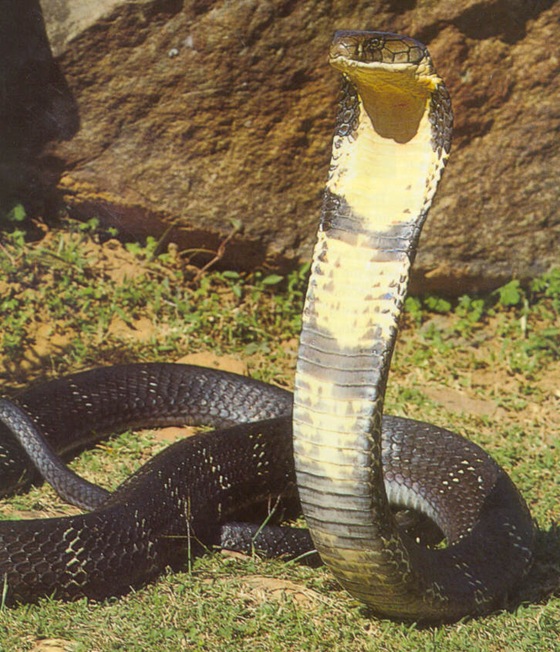
The King Cobra (Ophiophagus hannah) is the world’s longest venomous snake – growing up to 5.6 m (18.5 ft) in length. Ophiophagus, literally means “snake-eater” as it eats other snakes. One single bite of this deadly snake can easily kill a human. This snake is even capable of killing a full-grown Asian Elephant within 3 hours if the larger animal is bitten in a vulnerable area such as the trunk.
It’s venom is not as toxic as other venomous snakes, but King Cobra is capable of injecting 5 times more venom than black mamba and can result in mortality up to 5 times faster than that of the black mamba. It is quite widespread, ranging across South and South-east Asia, living in dense highland forests.

3. Marbled Cone Snail
03-most-poisonous-animals-in-the-world-marbled-cone-snail
This little beautiful looking Marbled Cone snail can be as deadly as any other animal on this list. One drop of its venom is so powerful that it can kill more than 20 humans. If you ever happen to be in warm salt water environment (where these snails are often found) and see it, don’t even think of picking it up. Of course, the true purpose of its venom is to catch its prey.
Symptoms of a cone snail sting can start immediately or can be delayed in onset for days. It results in intense pain, swelling, numbness and tingling. Severe cases involve muscle paralysis, vision changes and breathing failure. There is no antivenom. However, only about 30 human deaths have been recorded from cone snail envenomation.

4. Blue-Ringed Octopus
04-most-poisonous-animals-in-the-world-blue-ringed-octopus
The Blue-Ringed Octopus is very small, only the size of a golf ball, but its venom is so powerful that can kill a human. Actually it carries enough poison to kill 26 adult humans within minutes, and there is no antidote. They are currently recognized as one of the world’s most venomous animals.
Its painless bite may seem harmless, but the deadly neurotoxins begin working immediately resulting in muscular weakness, numbness, followed by a cessation and breathing and ultimately death.
They can be found in tide pools in the Pacific Ocean, from Japan to Australia.

5. Death Stalker Scorpion
Death Stalker Scorpion
Contrarily to the popular belief most of the scorpions are relatively harmless to humans as stings produce only local effects (pain, numbness or swelling). However, the Death Starker Scorpion is highly dangerous species because its venom is a powerful cocktail of neurotoxins which causes an intense and unbearable pain, then fever, followed by coma, convulsions, paralysis and death. Fortunately, while a sting from this scorpion is extremely painful, it would be unlikely to kill a healthy, adult human. Young children, the old, or infirm (with a heart condition) are at the biggest risk.
Death stalker scorpions are spread in North Africa and Middle East.

6. Stonefish
06-most-poisonous-animals-in-the-world-stonefish
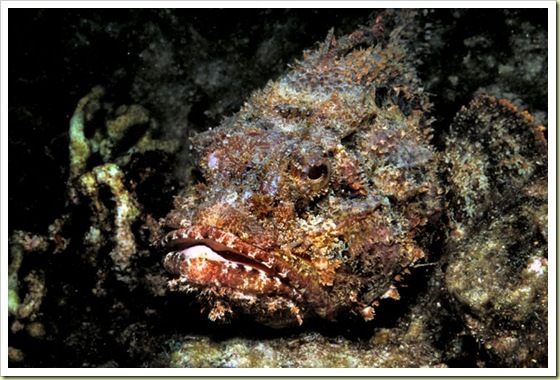
Maybe Stonefish would never win a beauty contest, but it would definitely win the top prize for being “The World Most Venomous Fish”. Its venom causes such a severe pain that the victims of its sting want the affected limb to be amputated. It is described as the worst pain known to man. It is accompanied with possible shock, paralysis, and tissue death. If not given medical attention within a couple of hours It can be fatal to humans.
Stonefish stores its toxins in gruesome-looking spines that are designed to hurt would-be predators.
Stonefish mostly live above the tropic of Capricorn, often found in the shallow tropical marine waters of the Pacific and Indian oceans, ranging from the Red Sea to the Queensland Great Barrier Reef.

7. The Brazilian wandering spider
The Brazilian wandering spider
The Brazilian Wandering Spider (Phoneutria) or banana spider appears in the Guinness Book of World Records 2007 for the most venomous spider and is the spider responsible for most human deaths.
This spider is believed to have the most potent neurotoxic venom of any living spider. Only 0.006mg (0.00000021oz) is sufficient to kill a mouse. They are also so dangerous because of their wandering nature. They often hide during daytime in highly populated areas inside houses, clothes, boots, and cars.
Its venomous bite causes not only intense pain, the venom of the spider can also cause priapism – uncomfortable erections lasting for many hours that lead to impotence.

8. Inland Taipan
Inland Taipan
The prize for “The World’s Most Venomous Snake” goes to the Inland Taipan of Australia. Just a single bite from this snake contains enough venom to kill 100 human adults or an army of 250,000 mice. Its venom is at least 200 – 400 times more toxic than a common cobra. The Inland Taiwan’s extremely neurotoxic venom can kill an adult human in as little as 45 minutes. Fortunately this snake is very shy and there have been no documented human fatalities (all known bites were treated with antivenin).

9. Poison Dart Frog
Poison Dart Frog
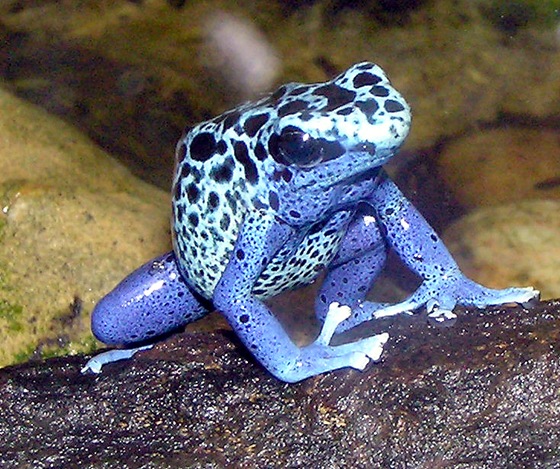
If you ever happen to be running through the rain forests somewhere in Central or South America, do not ever pick up beautiful and colorful frogs – it can be the Poison Dart Frog. This frog is probably the most poisonous animal on earth.The 2 inch long (5cm) golden poison dart frog has enough venom to kill 10 adult humans or 20,000 mice. Only 2 micrograms of this lethal toxin (the amount that fits on the head of a pin) is capable of killing a human or other large mammal. They are called “dart frogs” because indigenous Amerindians’ use of their toxic secretions to poison the tips of their blow-darts. Poison dart frogs keep their poison in their skins and will sicken or kill anybody who touches or eats it.

10. Puffer Fish
10-most-poisonous-animals-in-the-world-puffer-fish
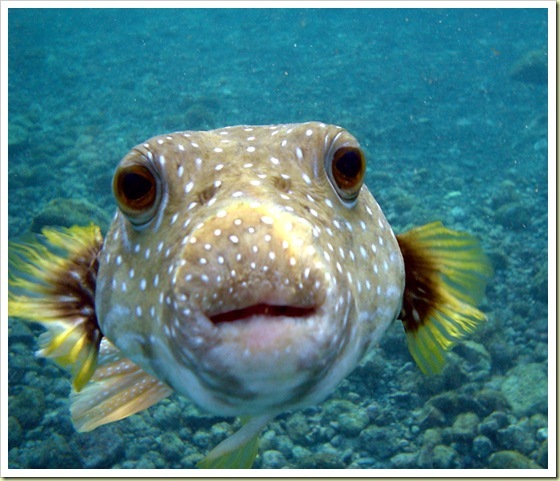
Puffer Fish are the second most poisonous vertebrate on earth (the first one is golden dart Frog). The meat of some species is a delicacy in both Japan (as fugu) and Korea (as bok-uh) but the problem is that the skin and certain organs of many puffer fish are very poisonous to humans.
This puffy fish produce rapid and violent death..Puffer’s poisoning causes deadening of the tongue and lips, dizziness, vomiting, rapid heart rate, difficulty breathing, and muscle paralysis. Victims die from suffocation as diaphragm muscles are paralyzed. Most of the victims die after four to 24 hours. There is no known antidote, Most deaths from fugu happen when untrained people catch and prepare the fish.
Statistics show that there were 20 to 44 incidents of fugu poisoning per year between 1996 and 2006 in all of Japan and up to six incidents per year led to death. Since Fugu’s poison can cause near instantaneous death, only licensed chefs are allowed to prepare it.